Fédération Internationale de Zénith Association
International Federation of Association Zenith
In Short...
Throw an object as high and as straight as possible.
The Basics
Definitions and Acronyms
-
Base
-
Catcher
-
CS, Catching Side
-
Contact
-
End
-
EOL, Establishing the Offensive Line
-
FOP, Field of Play
-
Fumble
-
Jet
-
Londt
-
Match
-
OL, Offensive Line
-
Pocket
-
Release
-
Result
-
Round
-
Run
-
TAR, Toss-and-Run
-
Team
-
Toss
-
Tosser
-
TS, Tossing Side
-
Zenith
Regulation & Specs
-
Total weight = 260g
-
Elasticity e = TBD
Distance
-
1 Jet = 66 cm (~ 1 pace)
Playing Area (recommended i.e. not mandatory)
-
Flat and regular enough to minimize tripping/sliding/falling
-
Radially large enough to accommodate what the fastest person can run within 3-4 seconds
-
If space is limited, then the field-of-play can be modified to limit which direction the Offense team can run
-
Setup
-
Place the Base somewhere on an appropriately sized field
-
The Base can be any object but shall not be larger than the Pocket
-
-
Mark up a circle around the base with a radius between 5-7 Jets. This is the Offense-line (OL).
-
This can be changed throughout the duration of the Match, but only at the beginning of an End. (see “Re-Establishing the Offense-Line”)
-
-
Form two teams
-
Decide which team will start on the Tossing-side (TS) and the Catching-side (CS)
-
Objective
-
The objective is to score as many Jets in a Round as possible.
-
A Round consists of each team playing on the TS and CS once
-
-
Jets from each Round are added together, until five Rounds have been played.
-
Five Rounds = an End
-
-
The team with the highest number of Jets at the end of an End is the winner of that End
-
The best of five Ends wins the Match
-
Playing a Round
EOL - Establishing the Offense-Line (OL)
-
At the start of the Match, the OL shall be set at 5-7 Jets. The team may decide depending on the quality of the terrain, skills of the players.
-
If there is a disagreement, then the Tossing-side shall make the final decision
-
-
Before the start of each End (or at the start of the Match), the Tossing-side (TS) may decide to establish a new OL
-
This is achieved by a Toss-and-Run (TAR)
-
The Result becomes the new OL
-
The TS may decide to redo the TAR but the second time will be determinant OL regardless of its Result.
-
If a new OL is not established by future teams, the most recently established OL by any team shall always used.
-
Tossing (Offence) - Scoring points
-
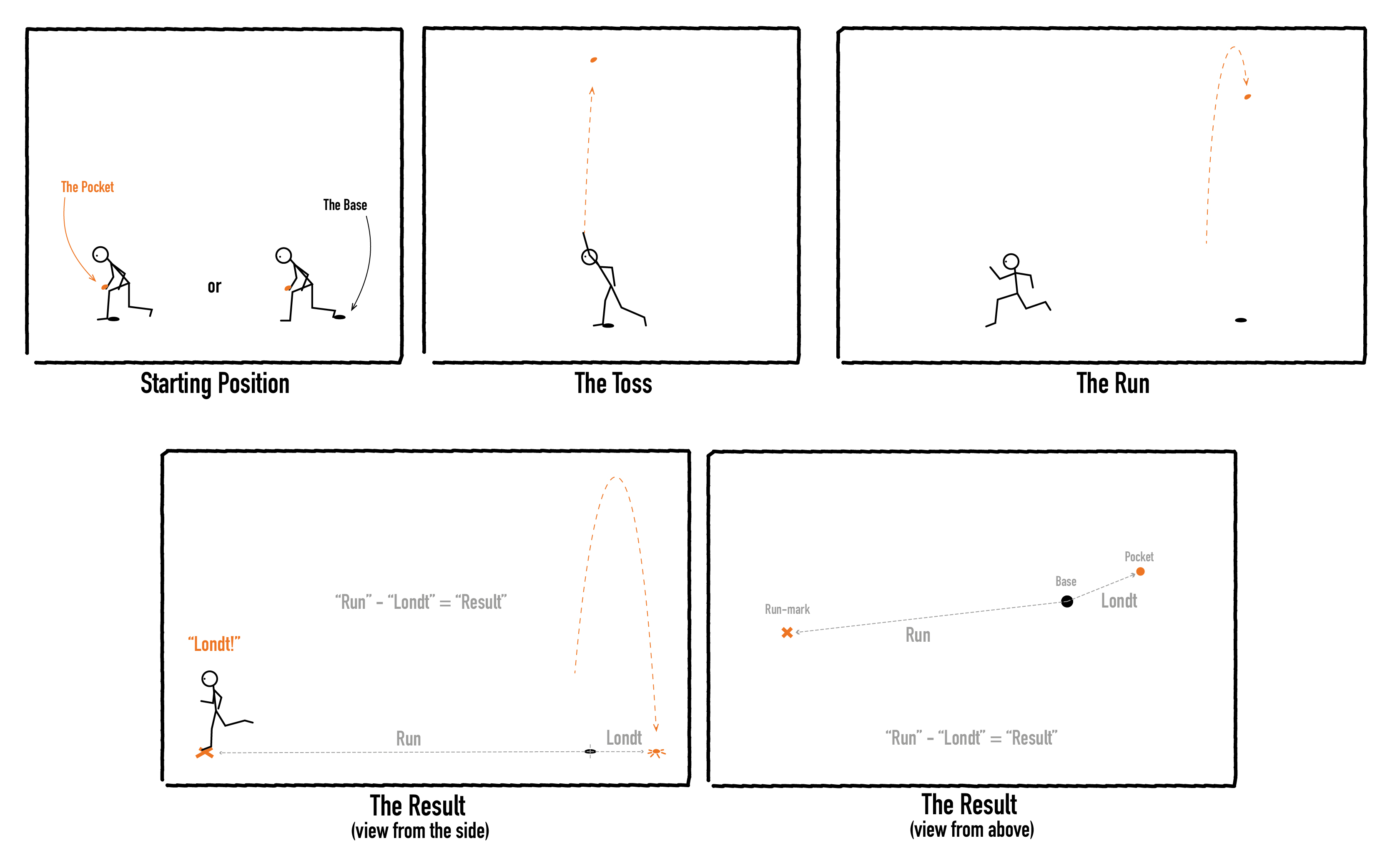
The first player on the Tossing-side prepares to Toss
-
This person is called the Tosser
-
The Tosser must be touching the Base
-
-
The Tosser throws the Pocket into the air
-
The Pocket’s zenith must be higher than the Tosser’s standing height (*consideration)
-
-
The Tosser Runs as far as possible until “Londt” is called by someone on the Tosser-side
-
The Tosser may not start the Run until the Pocket has been released
-
-
The moment “Londt” is called, the Catching-side marks where the Tosser’s foot strikes the ground. This is called the Run-mark.
-
The distance from the Base to the Run-mark is called “the Run”
-
The distance from the Base to the Pocket is called “the Londt”
-
The distance is measured in Jets (see Regulation Specs)
-
The distance is always rounded up to the next Jet
-
Jets = points
-
-
Each person on the Tossing-side makes a Toss until everyone has had a turn
-
Jets are added from each Tosser’s Result
-
-
Once everyone in the TS has Tossed, the TS switches to the CS
-
Each person on the TS may only Toss once per Round
Catching (Defense) - Preventing points being scored
-
One player from the Catching-side stands anywhere outside of the OL
-
This person is called the Catcher
-
They may not touch the OL
-
-
The Catcher may cross over the OL only at the moment the Pocket is released
-
If the Catcher catches the Pocket without letting it touch the ground, then Jets for the Tosser are denied
-
The catch must be made with the hand only. That is, if the Pocket touches any surface other than the Catcher's hand, the Pocket is considered fumbled. (*consideration: allow two hands?)
-
-
If the Catcher fumbles the Pocket, then the Londt is ignored during the determination of the Result
-
Every player on the Catching-side (CS) must attempt to catch at least once, unless there are less Tossers than Catchers
-
Once everyone in the TS has Tossed, the TS switches to the CS
Guard-rails / Rules / Considerations
-
The Catcher may not make contact with the Tosser
-
First time, warning and redo. Second time, Catcher is removed from the field for that Toss.
-
-
The Tosser may not Run until the Pocket is Tossed.
-
First time warning, second time the Run is forfeit. No Result is determined
-
-
The Catcher may not touch or cross the OL until the Pocket has been released
-
First time, warning and redo. Second time, Catcher is removed from the field for that Toss.
-
-
When a Toss is made, the Pocket’s zenith must be higher than the Tosser’s standing height
-
First time, warning and redo. Second time, the Run is ignored from the determination of the Result
-
-
The Tosser must make a Toss within 10 seconds after crossing over the OL
-
Otherwise, the Run is forfeit. No Result is determined.
-
-
The Tosser shall not make contact with the Pocket after it has been released
-
Otherwise, the Run is forfeit. No Result is determined.
-